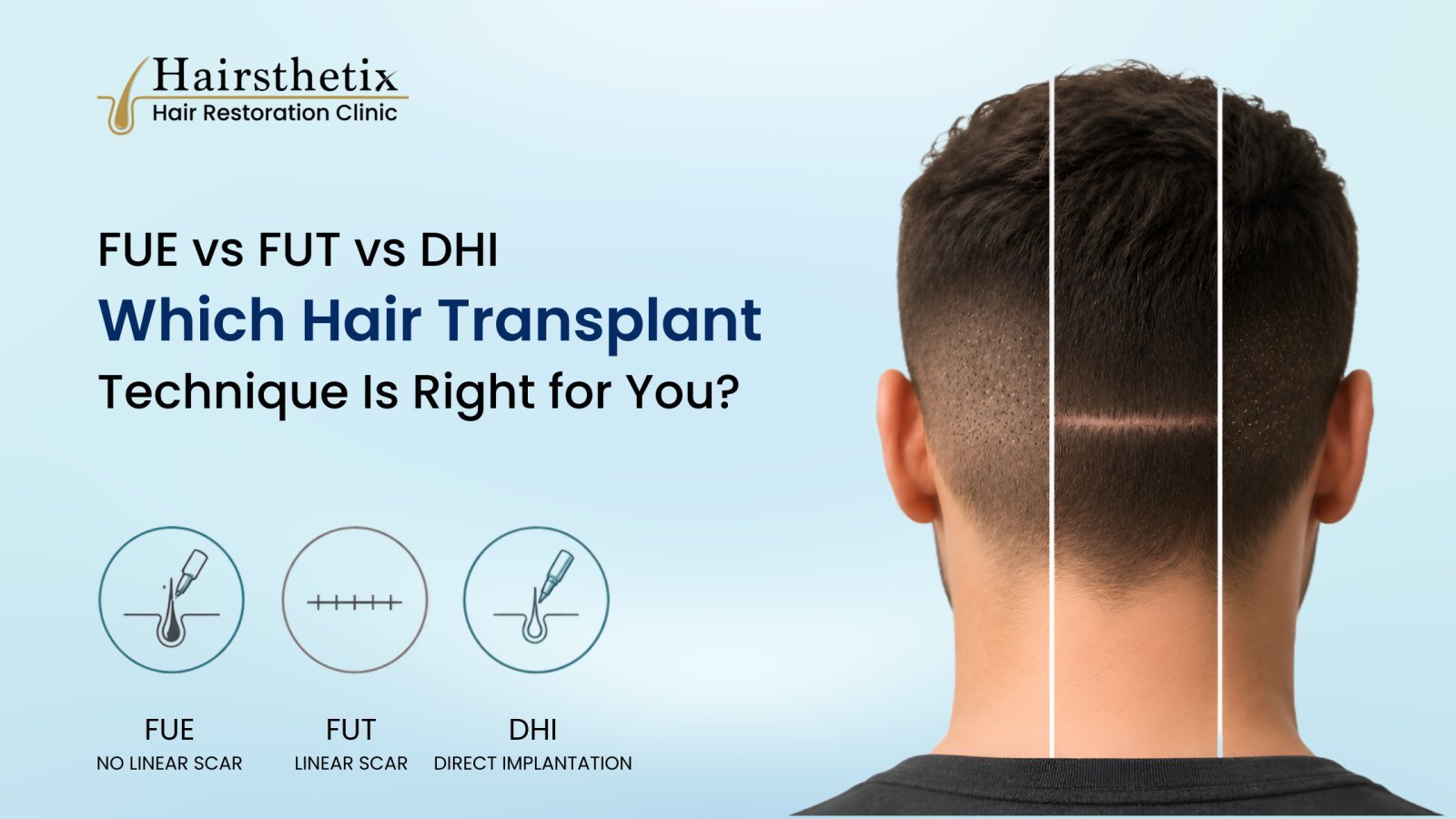
Choosing a hair transplant technique can feel overwhelming — FUE, FUT, and DHI can all produce natural, lasting results, but they work quite differently. The right choice depends on your hair loss pattern, lifestyle, budget, and how much downtime you can afford during your hair transplant journey.
This guide breaks down each method so you can walk into your consultation informed, ask your hair transplant doctor the right questions, and understand how your choice of technique affects the outcome of your hair transplant surgery.
What Is FUE (Follicular Unit Extraction)?
FUE involves extracting individual hair follicles directly from the donor area (usually the back of the scalp) and implanting them one by one into the balding area. It's one of the most widely used approaches to hair transplant surgery today.
Pros:
- Minimal, virtually invisible scarring — no linear scar
- Faster recovery time
- Suits patients who prefer shorter hairstyles
Considerations:
- Can take longer to perform for large sessions
- Typically a higher cost per graft compared to FUT
FUE has become a very popular technique thanks to its natural results and minimal visible scarring. If you want to see how this works in practice, check out our dedicated FUE hair transplant Cape Town page for full details and patient results in our gallery.
What Is FUT (Follicular Unit Transplantation)?
FUT, sometimes called the "strip method," involves removing a strip of scalp from the donor area, dissecting it into individual grafts under a microscope, and implanting them into the recipient area.
Pros:
- Can transplant a higher number of grafts in a single session
- Often a cost-effective option for large sessions
- Well-established, long track record
Considerations:
- Leaves a linear scar in the donor area
- Longer recovery time
- May be less suited to patients who prefer very short hairstyles
FUT can be a strong option for patients needing high graft volume in one sitting, with the trade-off being a scar line that's best kept covered by surrounding hair.
What Is DHI (Direct Hair Implantation)?
DHI is a refined version of FUE that uses a specialised pen-like tool (often called a Choi pen) to implant extracted follicles directly into the scalp — without first creating recipient site incisions.
Pros:
- Greater control over angle, depth, and direction of each hair
- Reduced time follicles spend outside the body, which can support graft survival
- No shaving required in some cases
Considerations:
- Typically the most expensive of the three techniques
- Requires a highly skilled, experienced technician
- Can be a slower process, so may need more sessions for high graft counts
Side-by-Side Comparison
FactorFUEFUTDHIScarringMinimal, dot scarsLinear scarMinimal, dot scarsRecovery timeModerateLongerModerateGraft precisionHighModerateVery highBest forMost patients, short hairstylesHigh graft volume needsPrecision hairline designRelative costModerate–highLower per graftHighest
How Technique Affects Your Hair Transplant Journey
The technique you choose shapes more than just the procedure itself — it affects your entire hair transplant journey, from consultation through to final results.
Pre-procedure planning: During your consultation, your hair transplant doctor assesses your donor density, scalp laxity, and hair loss pattern to recommend which technique suits your case. This is also when hair transplant cost is discussed in detail.
The day of surgery: FUE and DHI involve extracting individual follicles one at a time, which can make for a longer session but avoids a linear incision. FUT involves a single strip removal followed by microscopic dissection, which can be more efficient for very high graft counts.
Recovery: FUE and DHI patients typically experience less discomfort in the donor area and a shorter visible healing period. FUT patients may need a bit more care around the donor site during the first one to two weeks, though the area is usually well concealed once healed.
Long-term results: Regardless of technique, transplanted hair follows a similar growth pattern — initial shedding within the first few weeks, followed by new growth around three to four months, with fuller density developing over six to twelve months.
Which Technique Is Best for You?
There's no universal "best" technique — it depends on:
- Your hair loss stage — Advanced hair loss needing many grafts may suit FUT better for volume, or FUE/DHI split across sessions.
- Scarring preferences — If you like wearing your hair very short, FUE or DHI is generally preferable.
- Budget — FUT can be more economical for large sessions, while DHI commands a premium for its precision.
- Downtime tolerance — FUE and DHI generally offer quicker recovery than FUT.
The only way to know which technique truly fits your case is a professional scalp assessment. See our pricing page for treatment costs, or read our full guide on hair transplant cost in Cape Town to understand how technique choice affects your final price.
Why Your Hair Transplant Doctor Matters More Than the Technique Name
It's easy to get caught up in comparing FUE, FUT, and DHI as if the technique alone determines your result. In reality, the skill and experience of your hair transplant doctor plays just as large a role — if not larger. A well-executed FUT procedure by an experienced doctor can outperform a poorly executed FUE or DHI procedure, and vice versa.
What matters most is hairline design skill, careful graft handling for survival rate, and consistent angle and density matching your natural hair growth. When researching your options, it's worth asking any hair transplant doctor you consult about their specific experience with the technique you're considering, and asking to see real before-and-after results.
Cost Considerations Across Techniques
Since technique is one of the biggest factors in hair transplant cost, it's worth understanding roughly how they compare. FUT is often the most cost-effective option for very high graft counts. FUE typically sits at a moderate-to-higher price point due to the time required for individual follicle extraction. DHI is usually the most expensive, reflecting the specialised tools and technical skill required.
That said, technique is only one input into your final quote — graft count, donor quality, and any additional treatments like PRP or GFC will also factor into your total hair transplant cost. The best way to get a clear number is a consultation and scalp assessment.